Oh my! How could they SAY that?!
Switching Things Up By Beginning With Survey Responses
Survey Question: What does your partner do that drives you crazy (in a negative way)?
Responses:
- Simplistic thinking
- Poor memory
- Stubborn
- Not enough effort to learn my language
- Arguing back instead of conversing
- Poor communication about issues
- Picky eater
- Rash behaviors in new relationship
As you can see, conflict is inevitable in any romantic relationship. They are a normal and healthy part of two people trying to navigate their differences and learn what the other person likes or dislikes. I think about it like this—two rocks trying to smooth out each other's edges so that they fit better together as two stones.
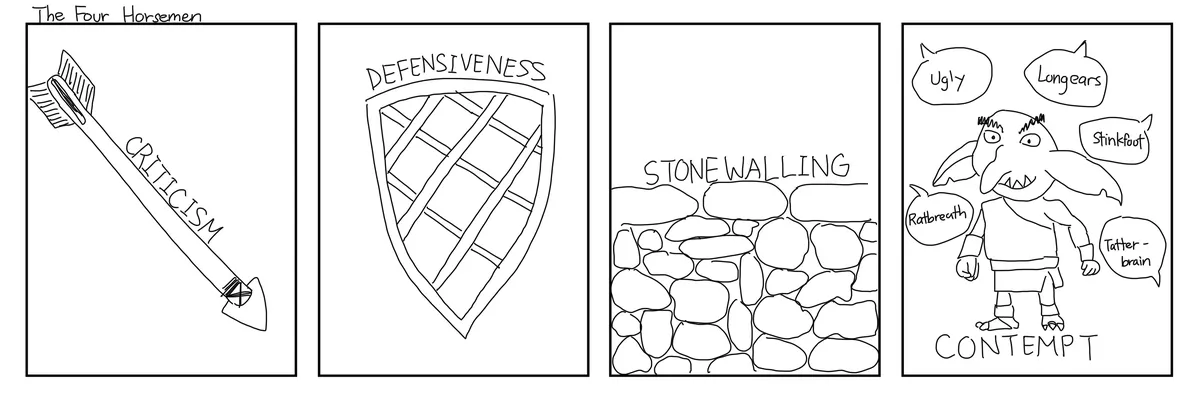
Due to the sheer amount in the types of conflict that exist, there is no one solution that fits all. However, there are right and wrong ways to go about resolving conflict. The main rule of thumb is to prioritize communication. The Four Horsemen of the Relationship Apocalypse described by Gottman are the four most harmful behaviors that indicate conflict and disillusion 93% of the time.
- Criticism — attacking partner's character instead of critiquing mistakes; blaming them for your experience of negative feelings such as disappointment
- Defensiveness — self-protection in the form of righteous indignation/innocent victimhood in an attempt to ward off a perceived attack
- Stonewalling — quite literally building a wall; in an argument: listener withdraws, shuts down, & closes themselves off from speaker due to feeling overwhelmed
- Contempt — arguably the worst & #1 predictor of divorce; includes: treating with disrespect, mocking with sarcasm & condescension, hostile humor, name-calling, eye-rolling, sneering, mimicking
Cognitive dissonance is created by inconsistencies among a person's thoughts, sentiments, and actions, which can cause an aversive emotional state (dissonance) that leads to efforts to restore consistency. In relationship conflicts, one can experience cognitive dissonance when they love their partner but say or do hurtful things to them. In this particular case, it is best to align behavior with attitudes by apologizing to your partner and reaffirming your feelings for them instead of changing attitudes to minimize what happened. It is important to know that humans strive for consistency, so cognitive dissonance is a powerful motivation for changing attitudes or behaviors, especially in the wake of a conflict.
A subordinate goal is a goal that transcends the interests of any one individual and can be readily achieved by the individuals working together. It is highly successful in conflict reduction because hostile feelings between the individuals are resolved after working cooperatively together. Whenever there's a conflict between partners, it may help to remind each other that you have the shared goal of working towards a healthier, more stable relationship. This may prevent any hurtful behaviors that detract from that goal.
Chapters covered:
- Chapter 9 (4 Horsemen)
- Chapter 6 (cognitive dissonance)
- Chapter 10 (subordinate goal)